学園の歴史 創設者「小野山利雄」先生について
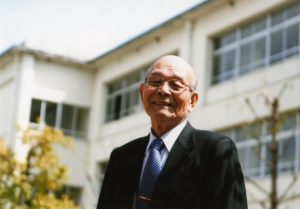
京都共栄学園の創設者小野山先生は、大正十四年現在の兵庫県養父郡広谷町に生まれました。戦後焼け野原となった神戸を目の当たりにして、「これからの日本を作るのは、若い世代であり、彼等を教育して優秀な人材を育てることが、日本の復興にとって最も肝要なことである。」と考えました。 福知山市に住まいを移した後、あらためて新制高校や短大の講師となりましたが、そのかたわら、昭和23年に「福知山珠算塾」を開設。翌年には珠算学校として認可され、珠算簿記学校、高等実務学校、経理専門学校へと学校を発展させていきました。
昭和32年には学校法人小野山学園の設立認可を受け、理事長に就任。地域社会、とりわけ北部の多くの中学校ならびに保護者から「何とか高等学校にしてほしい。」という要請を受けて、昭和35年には学校法人名を共栄学園と変更し、36年には「共栄高等学校」を開校することができました。
共栄高等学校は全日制普通科と商業科を持つ男女共学の学校としてスタートし、折からの生徒の急増期を背景に、第3回入学式では600名を超える生徒が入学、学校の体育館には入りきれず、市内の会館を借りて入学式を行うこととなりました。
高等学校が軌道に乗りはじめてすぐの昭和40年、小野山先生は約一ヵ月にわたりヨーロッパの教育現場を視察しました。のべ10カ国に及ぶこの研修で、先生は「日本では中学と高等学校という3年きざみに中等教育を分断しているが、このことが青少年への教育効果を阻害している要因の一つである。」ということに気付き、帰国後、いち早く中学校を開いて中高一貫教育を実現するという構想を発表しました。
まだ中高一貫教育が珍しかった時代の昭和43年、ついに「共栄学園中学校」が開校、「濃密学習」を展開するため二人制指導のバタビア教育システムが取り入れられました。その後二人制をとりやめた後も、共栄学園の中高一貫教育はバタビアコースという愛称で呼ばれ、一円の優秀な生徒が集まるようになり、京都北部の進学校として認められるまでになりました。
小野山先生は、昭和から平成にいたる間には、理事長・校長として校舎や体育館等を次々と整備し、校名を京都共栄学園とあらため、ほぼ現在の学園の姿を作りあげました。また、中等教育の機会均等のため単位制通信制課程を高校に設置し、中学高等学校の校長としては平成九年まで、そして理事長職は亡くなる平成22年の最期までつとめられました。
建学の精神と本学園のミッション
建学の精神は『自立共栄』
小野山先生曰く、「高邁なる理念を具体化し教育の機会均等、基礎基本の学業と、個人の資質を高めるために独自性による私学教育を行い、以て有為な人材の育成を図るを目的として学校を設置する。」
この精神の意味するところ
自立
『自立』・・・自ら生計を立てるという意味から、現在では『自律』の意味合いが強くなっている。自己実現、自己確立することが教育の第一目標。
共栄
『共栄』・・・自分だけが良くても意味がない。男と女、親と子、個人と社会、対極にあるようなものが、同時に幸福であることが、真の幸福である。そう考えられる人を教育する。
本学園のミッション(教育目標)は、『生徒の幸福な人生』を実現するために、理想の中学、高校6年間を提供すること。そして本学園で学んだ子供たちが、『利他』の心で『誰かのために、何かを頑張れる人』となり、真の『幸福』を実現し、ひいては社会全体の『幸福』につながるような良い人生を送ること。
『自立共栄』には、そんな想いがこめられています。
校訓
気魄
気概を持ち忍耐力を養い、
強い精神力を持つ人間
信念
自己を信じる心を持ち、
もの事をやり遂げる人間
自治
自ら考え、教養を養い、
自主的に処理できる人間
Founding Spirit and History of the Academy
About the Founder, Mr. Toshio Onoyama
The founder of Kyoto Kyoei Gakuen, Mr. Onoyama, was born in 1925 (Taisho 14) in Hirotani Town, Yabu District, Hyogo Prefecture. After witnessing the devastation of Kobe after the war, he strongly believed that “the future of Japan lies in the younger generation, and educating them to become outstanding individuals is the key to Japan’s recovery.”
After relocating to Fukuchiyama City, he became a lecturer at newly established high schools and junior colleges. In 1948 (Showa 23), he founded the “Fukuchiyama Abacus School,” which was officially recognized the following year. The school continued to grow, evolving into an abacus and bookkeeping school, a higher vocational school, and eventually a specialized accounting school.
In 1957 (Showa 32), he received approval to establish the Onoyama Gakuen educational foundation and assumed the role of chairman. In response to strong requests from local middle schools and parents to establish a high school, the foundation’s name was changed to Kyoei Gakuen in 1960 (Showa 35), and the following year, Kyoei High School was officially opened.
Kyoei High School began as a coeducational institution offering general and commercial courses. Due to the rapid increase in student enrollment at the time, by the third entrance ceremony, over 600 students were admitted, and the school had to rent a city hall for the ceremony as the gymnasium could not accommodate all attendees.
In 1965 (Showa 40), shortly after the high school became established, Mr. Onoyama spent about a month observing educational institutions across Europe. During his visits to ten countries, he realized that “in Japan, secondary education is divided into three-year increments (junior high and high school), which disrupts the effectiveness of adolescent education.” Upon returning to Japan, he quickly announced a plan to establish a junior high school and implement an integrated junior-senior high school education system.
At a time when such systems were still rare, Kyoei Gakuen Junior High School was opened in 1968 (Showa 43). To promote intensive learning, the school adopted the Batavia education system, which involved a dual-teacher approach. Even after discontinuing this system, the integrated junior-senior high education remained, becoming known as the Batavia Course and attracting outstanding students from the region. Eventually, Kyoei Gakuen gained recognition as a leading preparatory school in northern Kyoto.
From the Showa era into the Heisei era, Mr. Onoyama, serving as both chairman and principal, continuously developed the school by constructing new buildings and gymnasiums. The school was renamed Kyoto Kyoei Gakuen, establishing its current form. He also introduced a credit-based correspondence course in high school to promote equal opportunities in secondary education. He remained the principal of the junior and senior high school until 1997 (Heisei 9) and continued as chairman until his passing in 2010 (Heisei 22).
Founding Spirit and Mission
Founding Spirit: “Self-Reliance and Mutual Prosperity”
Mr. Onoyama stated:
“To realize lofty ideals, ensure equal educational opportunities, establish a private school system that nurtures fundamental academics and enhances individual potential, and foster talented individuals.”
Meaning of This Spirit
- Self-Reliance (Jiritsu)
Originally meaning financial independence, the concept has evolved to emphasize self-discipline. Achieving self-actualization and self-establishment is the primary goal of education. - Mutual Prosperity (Kyoei)
Individual success alone is meaningless. True happiness arises when seemingly opposite entities—men and women, parents and children, individuals and society—can prosper together. The school aims to nurture individuals who understand and embody this philosophy.
Mission of the Academy
The academy’s educational goal is to provide an ideal six-year junior and senior high school experience that enables students to lead happy and fulfilling lives. The ultimate objective is for students to develop a spirit of altruism, become individuals who strive for the benefit of others, attain true happiness, and contribute to the overall well-being of society.
“Self-Reliance and Mutual Prosperity” reflects this deep aspiration.
School Motto
- Spirit (Kihakku)
- Develop perseverance and a strong will.
- Conviction (Shinnen)
- Cultivate self-confidence and the determination to see things through.
- Autonomy (Jichi)
- Foster independent thinking, intellectual growth, and the ability to act proactively.